
Latest Insights
Blog details
Blog details
Explore practical insights on websites, SEO, online visibility, and digital strategy to help your business grow online.
Explore practical insights on websites, SEO, online visibility, and digital strategy to help your business grow online.
Website Design, Platform Migrations
WordPress, Shopify, Wix, Framer, or Webflow: Which Platform Is Right for Your Business?
Choosing the right website platform can impact your website's performance, flexibility, maintenance requirements, and long-term growth. Learn the strengths and weaknesses of WordPress, Shopify, Wix, Framer, and Webflow to determine which platform best fits your business.
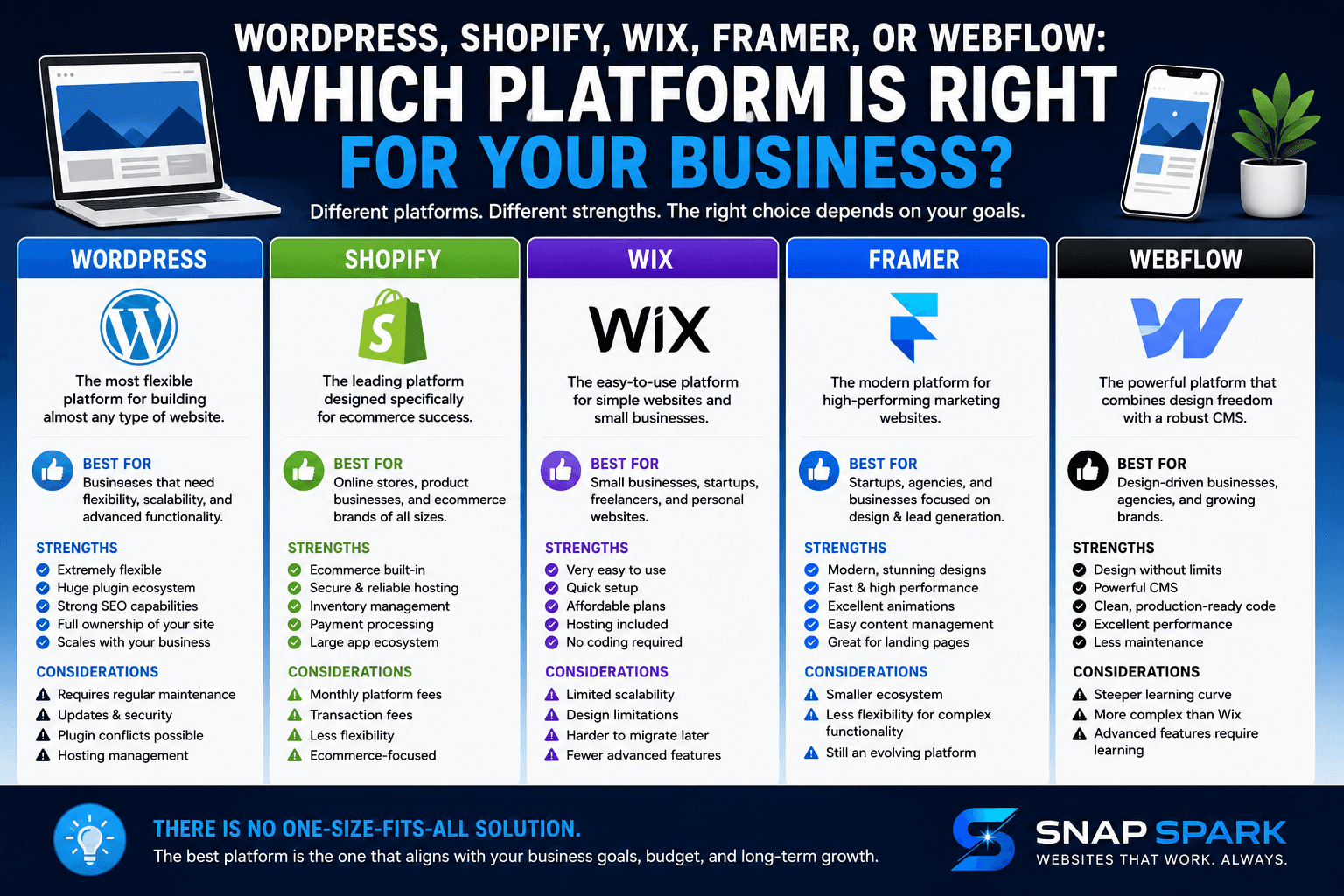
WordPress, Shopify, Wix, Framer, or Webflow: Which Platform Is Right for Your Business?
Choosing the right website platform is one of the most important decisions a business can make.
The platform you choose affects everything from design flexibility and search engine visibility to maintenance requirements, scalability, and long-term costs.
Unfortunately, many businesses choose a platform based on advertising, recommendations from friends, or whichever platform happens to be popular at the time.
The reality is that no single platform is the best choice for every business.
Each platform has strengths, weaknesses, ideal use cases, and limitations.
Understanding these differences can help you make a smarter investment and avoid expensive migrations later.
There Is No Perfect Website Platform
One of the biggest misconceptions in web design is that there is a "best" platform.
There isn't.
The best platform depends on:
Your business type
Your goals
Your budget
Your technical requirements
Your growth plans
Your content strategy
Your ecommerce needs
A platform that works perfectly for an online store may be a poor choice for a professional services company.
Likewise, a platform ideal for a marketing website may not be suitable for a business with hundreds of products.
The goal is to choose the right tool for the job.
WordPress
WordPress powers a significant portion of the internet and remains one of the most flexible website platforms available.
Its popularity comes largely from its ability to support everything from small business websites to large enterprise projects.
WordPress is often a strong choice for:
Service businesses
Professional services
Local businesses
Content-heavy websites
Membership websites
Businesses needing advanced functionality
Benefits of WordPress include:
Extremely flexible
Large plugin ecosystem
Strong SEO capabilities
Full ownership of content
Nearly unlimited customization
Huge developer community
Potential drawbacks include:
Ongoing maintenance requirements
Plugin conflicts
Security responsibilities
Software updates
Hosting management
For businesses that need flexibility and long-term scalability, WordPress remains one of the strongest options available.
Shopify
Shopify was built specifically for ecommerce.
While other platforms can support online stores, Shopify focuses almost entirely on selling products online.
Shopify is often ideal for:
Ecommerce brands
Retail stores
Product-based businesses
Subscription products
Direct-to-consumer companies
Benefits include:
Ecommerce-focused design
Reliable hosting
Secure payment processing
Inventory management
Order management
App ecosystem
Potential drawbacks include:
Monthly platform fees
Transaction costs
Limited flexibility compared to WordPress
Ecommerce-focused architecture that may not fit service businesses
For businesses primarily selling products online, Shopify is often one of the best solutions available.
Wix
Wix has become popular among small businesses looking for a simple way to create a website without technical knowledge.
Its drag-and-drop builder allows users to launch websites quickly.
Wix is commonly used by:
Small local businesses
Startups
Personal brands
Freelancers
New businesses with limited budgets
Benefits include:
Easy to use
Beginner friendly
Fast setup
Hosting included
Low learning curve
Potential drawbacks include:
Limited scalability
Less flexibility
Design limitations
More difficult migrations later
Fewer advanced customization options
Wix can be an excellent starting point for some businesses, but many eventually outgrow its capabilities as they expand.
Framer
Framer has rapidly become one of the most popular platforms for modern marketing websites.
It combines visual design freedom with impressive performance and clean user experiences.
Framer is often ideal for:
Service businesses
Agencies
Consultants
Startups
Marketing-focused websites
Professional brands
Benefits include:
Modern design capabilities
Fast loading speeds
Responsive design
Excellent user experience
Easy content management
Strong visual presentation
Potential drawbacks include:
Less flexibility than WordPress for advanced functionality
Smaller ecosystem
Limited support for highly complex applications
For businesses focused on lead generation, branding, and professional presentation, Framer has become a very attractive option.
Webflow
Webflow sits somewhere between traditional website builders and fully custom development.
It offers significant design flexibility while reducing many of the maintenance challenges associated with WordPress.
Webflow is commonly used by:
Agencies
Designers
Professional service companies
SaaS businesses
Growing brands
Benefits include:
Exceptional design flexibility
Built-in CMS
Strong performance
Clean code output
Reduced maintenance requirements
Powerful content management
Potential drawbacks include:
Steeper learning curve
Higher complexity than Wix
Advanced features may require specialized knowledge
Webflow is often a strong choice for businesses seeking custom design without the maintenance burden associated with traditional WordPress websites.
Which Platform Is Best for SEO?
One of the most common questions businesses ask is:
"Which platform ranks best on Google?"
The truth is that Google does not automatically favor one platform over another.
Successful SEO depends more on:
Website structure
Content quality
Technical optimization
Page speed
Mobile experience
Internal linking
User experience
WordPress, Shopify, Wix, Framer, and Webflow can all perform well when properly optimized.
The platform alone rarely determines success.
Execution matters far more.
Which Platform Is Best for Maintenance?
Maintenance requirements vary significantly between platforms.
Generally speaking:
WordPress requires the most ongoing maintenance.
Shopify handles much of the maintenance automatically.
Wix requires minimal maintenance.
Framer requires relatively little maintenance.
Webflow reduces many traditional maintenance concerns.
Businesses that prefer a hands-off approach often gravitate toward hosted platforms.
Businesses requiring maximum flexibility often accept the additional maintenance responsibilities associated with WordPress.
Which Platform Is Best for Long-Term Growth?
Growth should always be considered when selecting a platform.
Questions to ask include:
Will the website need ecommerce?
Will content expand significantly?
Will additional functionality be required?
Will marketing efforts increase?
Will multiple team members manage content?
The answers often help determine which platform is best suited for future needs.
Choosing a platform that supports both current and future goals can prevent expensive migrations later.
When Should You Consider a Platform Migration?
Many businesses eventually outgrow their existing platform.
Common reasons for migration include:
Performance issues
Design limitations
Ecommerce needs
Maintenance concerns
Rebranding
Growth requirements
Better content management
A properly planned migration can improve performance, user experience, and future scalability while minimizing disruption.
Final Thoughts
WordPress, Shopify, Wix, Framer, and Webflow are all capable platforms, but they serve different purposes.
The best platform is not necessarily the most popular platform. It is the platform that best aligns with your business goals, marketing strategy, budget, and long-term growth plans.
Before investing in a new website or considering a migration, take the time to evaluate how your website supports your business today and where your business is headed in the future.
Making the right platform decision now can save significant time, money, and frustration down the road.
WordPress, Shopify, Wix, Framer, or Webflow: Which Platform Is Right for Your Business?
Choosing the right website platform is one of the most important decisions a business can make.
The platform you choose affects everything from design flexibility and search engine visibility to maintenance requirements, scalability, and long-term costs.
Unfortunately, many businesses choose a platform based on advertising, recommendations from friends, or whichever platform happens to be popular at the time.
The reality is that no single platform is the best choice for every business.
Each platform has strengths, weaknesses, ideal use cases, and limitations.
Understanding these differences can help you make a smarter investment and avoid expensive migrations later.
There Is No Perfect Website Platform
One of the biggest misconceptions in web design is that there is a "best" platform.
There isn't.
The best platform depends on:
Your business type
Your goals
Your budget
Your technical requirements
Your growth plans
Your content strategy
Your ecommerce needs
A platform that works perfectly for an online store may be a poor choice for a professional services company.
Likewise, a platform ideal for a marketing website may not be suitable for a business with hundreds of products.
The goal is to choose the right tool for the job.
WordPress
WordPress powers a significant portion of the internet and remains one of the most flexible website platforms available.
Its popularity comes largely from its ability to support everything from small business websites to large enterprise projects.
WordPress is often a strong choice for:
Service businesses
Professional services
Local businesses
Content-heavy websites
Membership websites
Businesses needing advanced functionality
Benefits of WordPress include:
Extremely flexible
Large plugin ecosystem
Strong SEO capabilities
Full ownership of content
Nearly unlimited customization
Huge developer community
Potential drawbacks include:
Ongoing maintenance requirements
Plugin conflicts
Security responsibilities
Software updates
Hosting management
For businesses that need flexibility and long-term scalability, WordPress remains one of the strongest options available.
Shopify
Shopify was built specifically for ecommerce.
While other platforms can support online stores, Shopify focuses almost entirely on selling products online.
Shopify is often ideal for:
Ecommerce brands
Retail stores
Product-based businesses
Subscription products
Direct-to-consumer companies
Benefits include:
Ecommerce-focused design
Reliable hosting
Secure payment processing
Inventory management
Order management
App ecosystem
Potential drawbacks include:
Monthly platform fees
Transaction costs
Limited flexibility compared to WordPress
Ecommerce-focused architecture that may not fit service businesses
For businesses primarily selling products online, Shopify is often one of the best solutions available.
Wix
Wix has become popular among small businesses looking for a simple way to create a website without technical knowledge.
Its drag-and-drop builder allows users to launch websites quickly.
Wix is commonly used by:
Small local businesses
Startups
Personal brands
Freelancers
New businesses with limited budgets
Benefits include:
Easy to use
Beginner friendly
Fast setup
Hosting included
Low learning curve
Potential drawbacks include:
Limited scalability
Less flexibility
Design limitations
More difficult migrations later
Fewer advanced customization options
Wix can be an excellent starting point for some businesses, but many eventually outgrow its capabilities as they expand.
Framer
Framer has rapidly become one of the most popular platforms for modern marketing websites.
It combines visual design freedom with impressive performance and clean user experiences.
Framer is often ideal for:
Service businesses
Agencies
Consultants
Startups
Marketing-focused websites
Professional brands
Benefits include:
Modern design capabilities
Fast loading speeds
Responsive design
Excellent user experience
Easy content management
Strong visual presentation
Potential drawbacks include:
Less flexibility than WordPress for advanced functionality
Smaller ecosystem
Limited support for highly complex applications
For businesses focused on lead generation, branding, and professional presentation, Framer has become a very attractive option.
Webflow
Webflow sits somewhere between traditional website builders and fully custom development.
It offers significant design flexibility while reducing many of the maintenance challenges associated with WordPress.
Webflow is commonly used by:
Agencies
Designers
Professional service companies
SaaS businesses
Growing brands
Benefits include:
Exceptional design flexibility
Built-in CMS
Strong performance
Clean code output
Reduced maintenance requirements
Powerful content management
Potential drawbacks include:
Steeper learning curve
Higher complexity than Wix
Advanced features may require specialized knowledge
Webflow is often a strong choice for businesses seeking custom design without the maintenance burden associated with traditional WordPress websites.
Which Platform Is Best for SEO?
One of the most common questions businesses ask is:
"Which platform ranks best on Google?"
The truth is that Google does not automatically favor one platform over another.
Successful SEO depends more on:
Website structure
Content quality
Technical optimization
Page speed
Mobile experience
Internal linking
User experience
WordPress, Shopify, Wix, Framer, and Webflow can all perform well when properly optimized.
The platform alone rarely determines success.
Execution matters far more.
Which Platform Is Best for Maintenance?
Maintenance requirements vary significantly between platforms.
Generally speaking:
WordPress requires the most ongoing maintenance.
Shopify handles much of the maintenance automatically.
Wix requires minimal maintenance.
Framer requires relatively little maintenance.
Webflow reduces many traditional maintenance concerns.
Businesses that prefer a hands-off approach often gravitate toward hosted platforms.
Businesses requiring maximum flexibility often accept the additional maintenance responsibilities associated with WordPress.
Which Platform Is Best for Long-Term Growth?
Growth should always be considered when selecting a platform.
Questions to ask include:
Will the website need ecommerce?
Will content expand significantly?
Will additional functionality be required?
Will marketing efforts increase?
Will multiple team members manage content?
The answers often help determine which platform is best suited for future needs.
Choosing a platform that supports both current and future goals can prevent expensive migrations later.
When Should You Consider a Platform Migration?
Many businesses eventually outgrow their existing platform.
Common reasons for migration include:
Performance issues
Design limitations
Ecommerce needs
Maintenance concerns
Rebranding
Growth requirements
Better content management
A properly planned migration can improve performance, user experience, and future scalability while minimizing disruption.
Final Thoughts
WordPress, Shopify, Wix, Framer, and Webflow are all capable platforms, but they serve different purposes.
The best platform is not necessarily the most popular platform. It is the platform that best aligns with your business goals, marketing strategy, budget, and long-term growth plans.
Before investing in a new website or considering a migration, take the time to evaluate how your website supports your business today and where your business is headed in the future.
Making the right platform decision now can save significant time, money, and frustration down the road.
Recent post
Ready to Strengthen Your Online Presence?
Whether you need a new website, better visibility on Google, or a strategy for growth, Snap Spark can help you build a stronger digital presence.
Ready to Strengthen Your Online Presence?
Whether you need a new website, better visibility on Google, or a strategy for growth, Snap Spark can help you build a stronger digital presence.
Ready to Strengthen Your Online Presence?
Whether you need a new website, better visibility on Google, or a strategy for growth, Snap Spark can help you build a stronger digital presence.