
Latest Insights
Blog details
Blog details
Explore practical insights on websites, SEO, online visibility, and digital strategy to help your business grow online.
Explore practical insights on websites, SEO, online visibility, and digital strategy to help your business grow online.
Website Design
How Often Should You Redesign Your Website?
Learn the warning signs that indicate your website may be outdated and discover how regular updates, redesigns, and performance improvements can help your business stay competitive online.
Why Website Redesigns Matter
Many business owners view a website as a one-time project.
The website gets built, launched, and then largely ignored for years. Unfortunately, the internet doesn't stand still. Technology evolves, customer expectations change, and search engines continuously update how they evaluate websites.
A website that looked modern five years ago may now appear outdated, load slowly, or fail to meet today's user expectations.
The question isn't whether your website will eventually need a redesign.
The question is whether you'll recognize the warning signs before it begins costing you customers.
There Is No Universal Timeline
One of the most common questions businesses ask is:
"How often should I redesign my website?"
The answer depends on several factors, including:
Your industry
Website platform
Business goals
Competition
Technology changes
User behavior
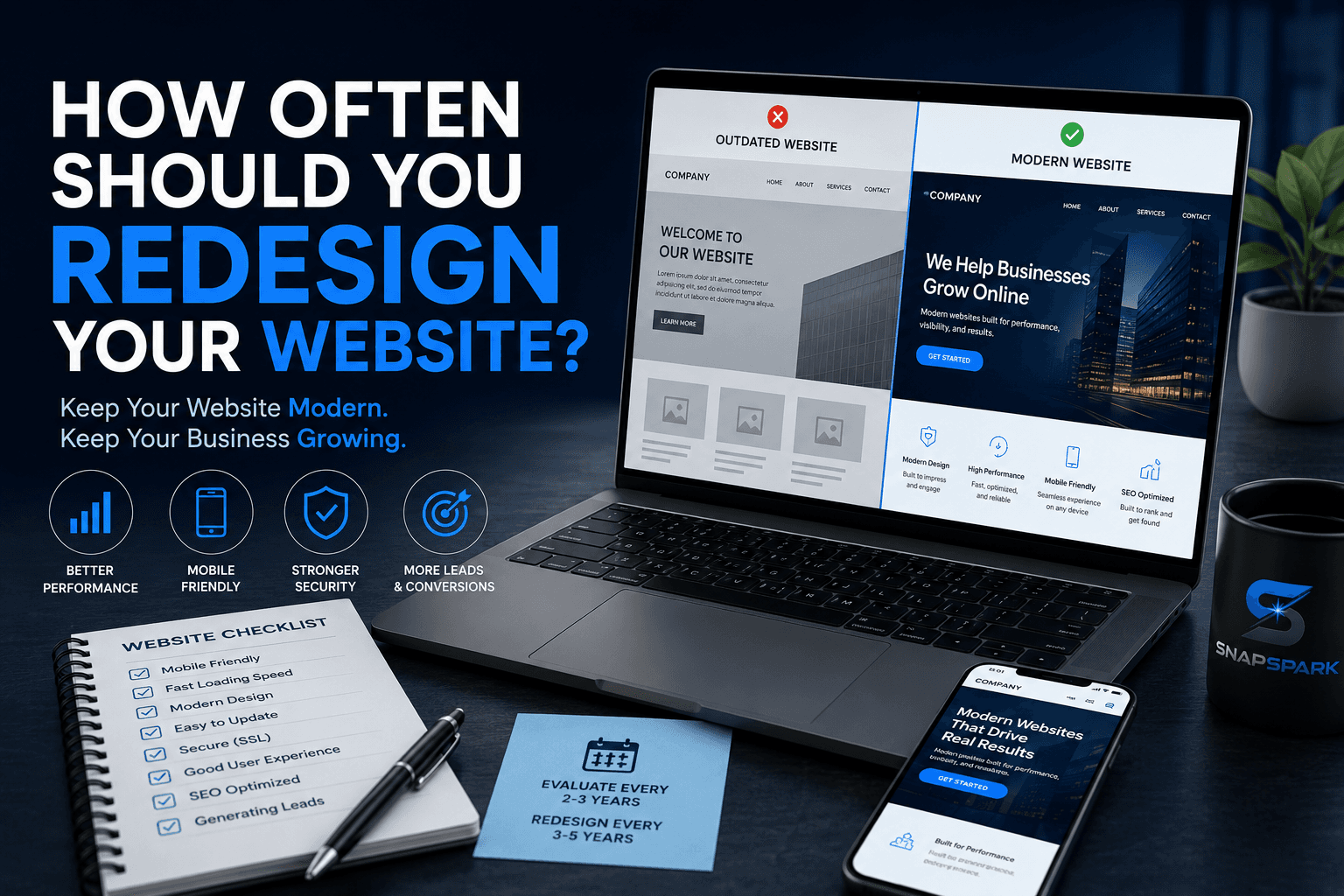
Most businesses should evaluate their website every 2 to 3 years and seriously consider a redesign every 3 to 5 years.
However, some websites require updates sooner while others can remain effective for longer periods with proper maintenance.
The Internet Changes Faster Than Most Businesses
A website launched in 2020 may have been considered modern at the time.
Since then, major changes have occurred in:
Mobile browsing habits
Website performance standards
Search engine algorithms
User expectations
Security requirements
Design trends
Accessibility standards
What worked a few years ago may no longer provide the same results today.
Businesses that fail to adapt often find themselves losing visibility and leads to competitors with more modern websites.
Signs Your Website May Need a Redesign
There are several warning signs that indicate your website may be holding your business back.
It Doesn't Look Modern
First impressions matter.
Visitors often form an opinion about a business within seconds of landing on a website.
If your website looks outdated compared to competitors, potential customers may question the quality of your products or services before ever contacting you.
It Isn't Mobile Friendly
Mobile traffic now accounts for the majority of website visits across many industries.
If visitors must zoom, scroll horizontally, or struggle to navigate your website on a phone, you likely have a problem.
Google also prioritizes mobile-friendly websites when determining search rankings.
It's Difficult to Update
Many older websites were built using platforms or systems that make updates difficult.
If every content change requires a developer, your website may be limiting your ability to grow.
Modern websites should make updating content, images, and pages significantly easier.
The Website Loads Slowly
Website speed affects:
User experience
Search rankings
Conversion rates
Bounce rates
Research consistently shows that users abandon slow websites.
Even a few extra seconds of loading time can reduce conversions and increase visitor abandonment.
Your Competitors Look Better
One of the easiest ways to evaluate your website is to compare it to competitors.
Visit the websites of businesses competing for the same customers.
Ask yourself:
Which website looks more professional?
Which website is easier to use?
Which website builds more trust?
Which website would you contact first?
If competitors consistently provide a better experience, a redesign may be necessary.
The Hidden Cost of an Outdated Website
Many businesses underestimate how much an outdated website costs them.
A poor website can result in:
Lost leads
Lower trust
Reduced conversions
Fewer phone calls
Higher bounce rates
Lower search visibility
These losses often happen gradually, making them difficult to identify.
Over time, however, the impact can become significant.
Redesign vs. Website Cleanup
Not every website needs a complete redesign.
In many cases, businesses can achieve excellent results through targeted improvements.
Examples include:
Content updates
Performance optimization
Design refinements
Navigation improvements
Technical SEO fixes
Mobile usability improvements
Sometimes a website cleanup can extend the life of a website by several years without requiring a full rebuild.
The challenge is knowing when improvements are enough and when a complete redesign is the smarter investment.
Modern Websites Must Do More Than Look Good
A successful website today must balance multiple objectives.
It should:
Load quickly
Work on all devices
Rank well in search engines
Build trust
Generate leads
Guide visitors toward action
Be easy to maintain
Design alone is no longer enough.
A beautiful website that fails to generate inquiries or support business goals is still underperforming.
Questions Every Business Owner Should Ask
When evaluating a website, consider the following:
Does the website represent the business professionally?
Is it generating leads?
Is it mobile friendly?
Does it load quickly?
Is it easy to update?
Does it rank well in search results?
Does it provide a good user experience?
Does it support current business goals?
If several of these answers are "no," it may be time to consider significant improvements.
When a Full Redesign Makes Sense
A complete redesign is often the best solution when:
The website is more than five years old
The platform is outdated
Mobile usability is poor
Performance issues are widespread
Branding has changed
Business goals have evolved
Lead generation is underperforming
Rather than continually patching an aging website, rebuilding from the ground up can often provide a better long-term return on investment.
Final Thoughts
Your website is often the first impression customers have of your business.
Just as you would maintain a physical storefront, your website requires regular evaluation, updates, and improvements to remain effective.
While there is no perfect timeline for every business, most websites benefit from ongoing maintenance and periodic redesigns to keep pace with technology, customer expectations, and search engine requirements.
The businesses that treat their website as an ongoing business asset rather than a one-time project are often the ones that achieve the strongest long-term results online.
Why Website Redesigns Matter
Many business owners view a website as a one-time project.
The website gets built, launched, and then largely ignored for years. Unfortunately, the internet doesn't stand still. Technology evolves, customer expectations change, and search engines continuously update how they evaluate websites.
A website that looked modern five years ago may now appear outdated, load slowly, or fail to meet today's user expectations.
The question isn't whether your website will eventually need a redesign.
The question is whether you'll recognize the warning signs before it begins costing you customers.
There Is No Universal Timeline
One of the most common questions businesses ask is:
"How often should I redesign my website?"
The answer depends on several factors, including:
Your industry
Website platform
Business goals
Competition
Technology changes
User behavior
Most businesses should evaluate their website every 2 to 3 years and seriously consider a redesign every 3 to 5 years.
However, some websites require updates sooner while others can remain effective for longer periods with proper maintenance.
The Internet Changes Faster Than Most Businesses
A website launched in 2020 may have been considered modern at the time.
Since then, major changes have occurred in:
Mobile browsing habits
Website performance standards
Search engine algorithms
User expectations
Security requirements
Design trends
Accessibility standards
What worked a few years ago may no longer provide the same results today.
Businesses that fail to adapt often find themselves losing visibility and leads to competitors with more modern websites.
Signs Your Website May Need a Redesign
There are several warning signs that indicate your website may be holding your business back.
It Doesn't Look Modern
First impressions matter.
Visitors often form an opinion about a business within seconds of landing on a website.
If your website looks outdated compared to competitors, potential customers may question the quality of your products or services before ever contacting you.
It Isn't Mobile Friendly
Mobile traffic now accounts for the majority of website visits across many industries.
If visitors must zoom, scroll horizontally, or struggle to navigate your website on a phone, you likely have a problem.
Google also prioritizes mobile-friendly websites when determining search rankings.
It's Difficult to Update
Many older websites were built using platforms or systems that make updates difficult.
If every content change requires a developer, your website may be limiting your ability to grow.
Modern websites should make updating content, images, and pages significantly easier.
The Website Loads Slowly
Website speed affects:
User experience
Search rankings
Conversion rates
Bounce rates
Research consistently shows that users abandon slow websites.
Even a few extra seconds of loading time can reduce conversions and increase visitor abandonment.
Your Competitors Look Better
One of the easiest ways to evaluate your website is to compare it to competitors.
Visit the websites of businesses competing for the same customers.
Ask yourself:
Which website looks more professional?
Which website is easier to use?
Which website builds more trust?
Which website would you contact first?
If competitors consistently provide a better experience, a redesign may be necessary.
The Hidden Cost of an Outdated Website
Many businesses underestimate how much an outdated website costs them.
A poor website can result in:
Lost leads
Lower trust
Reduced conversions
Fewer phone calls
Higher bounce rates
Lower search visibility
These losses often happen gradually, making them difficult to identify.
Over time, however, the impact can become significant.
Redesign vs. Website Cleanup
Not every website needs a complete redesign.
In many cases, businesses can achieve excellent results through targeted improvements.
Examples include:
Content updates
Performance optimization
Design refinements
Navigation improvements
Technical SEO fixes
Mobile usability improvements
Sometimes a website cleanup can extend the life of a website by several years without requiring a full rebuild.
The challenge is knowing when improvements are enough and when a complete redesign is the smarter investment.
Modern Websites Must Do More Than Look Good
A successful website today must balance multiple objectives.
It should:
Load quickly
Work on all devices
Rank well in search engines
Build trust
Generate leads
Guide visitors toward action
Be easy to maintain
Design alone is no longer enough.
A beautiful website that fails to generate inquiries or support business goals is still underperforming.
Questions Every Business Owner Should Ask
When evaluating a website, consider the following:
Does the website represent the business professionally?
Is it generating leads?
Is it mobile friendly?
Does it load quickly?
Is it easy to update?
Does it rank well in search results?
Does it provide a good user experience?
Does it support current business goals?
If several of these answers are "no," it may be time to consider significant improvements.
When a Full Redesign Makes Sense
A complete redesign is often the best solution when:
The website is more than five years old
The platform is outdated
Mobile usability is poor
Performance issues are widespread
Branding has changed
Business goals have evolved
Lead generation is underperforming
Rather than continually patching an aging website, rebuilding from the ground up can often provide a better long-term return on investment.
Final Thoughts
Your website is often the first impression customers have of your business.
Just as you would maintain a physical storefront, your website requires regular evaluation, updates, and improvements to remain effective.
While there is no perfect timeline for every business, most websites benefit from ongoing maintenance and periodic redesigns to keep pace with technology, customer expectations, and search engine requirements.
The businesses that treat their website as an ongoing business asset rather than a one-time project are often the ones that achieve the strongest long-term results online.
Recent post
Ready to Strengthen Your Online Presence?
Whether you need a new website, better visibility on Google, or a strategy for growth, Snap Spark can help you build a stronger digital presence.
Ready to Strengthen Your Online Presence?
Whether you need a new website, better visibility on Google, or a strategy for growth, Snap Spark can help you build a stronger digital presence.
Ready to Strengthen Your Online Presence?
Whether you need a new website, better visibility on Google, or a strategy for growth, Snap Spark can help you build a stronger digital presence.