
Latest Insights
Blog details
Blog details
Explore practical insights on websites, SEO, online visibility, and digital strategy to help your business grow online.
Explore practical insights on websites, SEO, online visibility, and digital strategy to help your business grow online.
Website Design, Lead Generation, Conversion Optimization, User Experience, Digital Marketing
Why Your Website Looks Fine but Still Isn't Generating Leads
Many business owners assume a professional-looking website is enough to generate leads. Learn why appearance alone isn't enough and discover the factors that influence whether visitors become customers.
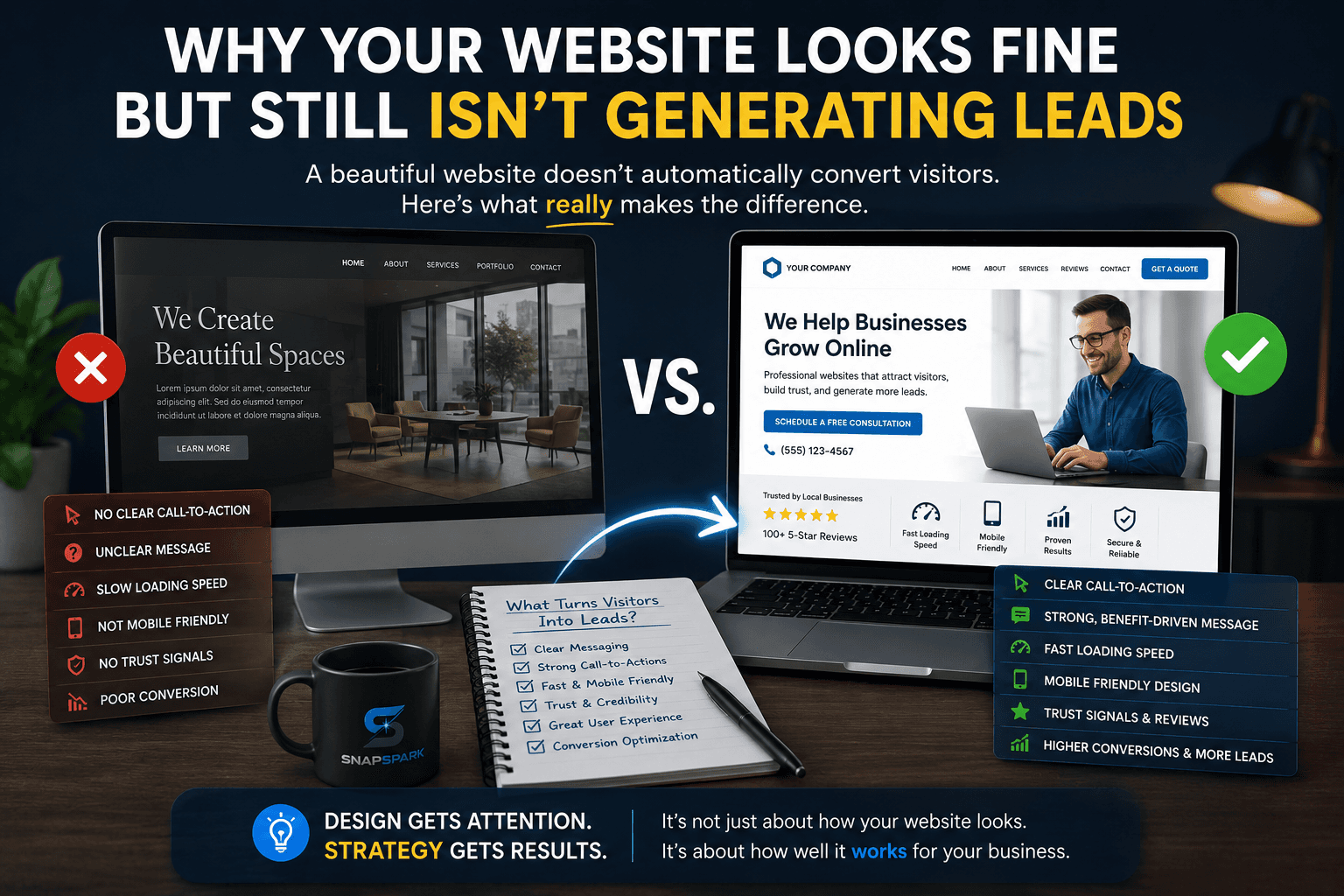
Why Your Website Looks Fine but Still Isn't Generating Leads
Many business owners believe that if their website looks professional, it should automatically generate leads.
The reality is that appearance alone does not determine whether a website succeeds or fails.
A website can have modern colors, professional photos, and attractive design elements while still producing very few phone calls, form submissions, or sales.
The problem is that most websites are judged by how they look rather than how they perform.
A successful website is not simply a digital brochure. It is a business tool designed to attract visitors, build trust, and encourage action.
If your website looks good but isn't producing results, there is usually a reason.
A Good-Looking Website Is Not the Same as a High-Performing Website
Many businesses invest heavily in design but spend very little time thinking about what happens after a visitor arrives.
Ask yourself:
Do visitors know what you do within five seconds?
Is it obvious who your services are for?
Can visitors easily contact you?
Is there a clear next step?
Does the website build trust?
If the answer to any of these questions is no, your website may be losing potential customers before they ever reach out.
The goal is not simply to impress visitors.
The goal is to convert visitors into leads.
Most Visitors Make Decisions Quickly
Website visitors are not reading every word on every page.
Most people scan.
Research consistently shows that visitors form opinions about websites within seconds.
During that short period, they are evaluating:
Professionalism
Credibility
Trustworthiness
Ease of use
Relevance
If they cannot quickly determine whether your business can help them, they often leave and continue searching.
This is why clear messaging is often more important than flashy design.
Your Value Proposition May Not Be Clear
One of the most common problems found on business websites is unclear messaging.
Many websites spend too much time talking about the company and not enough time explaining how they help customers.
Visitors want answers to simple questions:
What do you do?
Who do you help?
Why should I choose you?
What should I do next?
If those answers are difficult to find, visitors are more likely to leave.
Weak Calls-to-Action Hurt Conversions
A surprising number of websites never clearly tell visitors what to do.
A call-to-action is any element that encourages the visitor to take the next step.
Examples include:
Request a Quote
Schedule a Consultation
Call Now
Get Started
Contact Us
Without strong calls-to-action, visitors may leave even if they are interested in your services.
Many websites assume visitors will figure out what to do next.
The highest-performing websites remove that uncertainty.
Mobile Experience Matters More Than Ever
For many businesses, most website traffic now comes from mobile devices.
A website that works perfectly on a desktop computer may create a frustrating experience on a smartphone.
Common mobile issues include:
Small text
Difficult navigation
Slow loading speeds
Buttons that are hard to tap
Poor layouts
Forms that are difficult to complete
If visitors struggle to use your website on a mobile device, conversion rates often suffer.
Website Speed Directly Impacts Results
Speed is one of the most overlooked factors affecting lead generation.
Users expect websites to load quickly.
When a website loads slowly, visitors often leave before they even see the content.
Slow websites can lead to:
Higher bounce rates
Lower engagement
Reduced trust
Lower search rankings
Fewer conversions
A visually impressive website that loads slowly may perform worse than a simpler website that loads quickly.
Trust Signals Influence Buying Decisions
Before contacting a business, visitors often look for evidence that they can trust the company.
Trust signals include:
Customer reviews
Testimonials
Certifications
Awards
Case studies
Portfolio examples
Years of experience
Industry affiliations
Many websites fail to showcase these elements effectively.
Without trust signals, visitors may hesitate to take action.
Contact Forms Can Be a Major Problem
Many business owners never test their own contact forms.
Unfortunately, broken forms are more common than people realize.
Other common issues include:
Forms asking for too much information
Poor mobile usability
Confusing instructions
Technical errors
Lack of confirmation messages
Even small form issues can significantly reduce lead generation.
A website should make contacting your business as easy as possible.
Visitors Need a Reason to Choose You
Many websites focus heavily on features but fail to communicate value.
Customers care less about what you do and more about how you help them.
Instead of listing features, focus on benefits.
For example:
Instead of saying:
"Custom website design services."
Explain:
"Professional websites designed to improve credibility, increase visibility, and generate more qualified leads."
The difference may seem small, but it can dramatically improve conversions.
SEO Traffic Means Nothing Without Conversion
Many businesses focus exclusively on increasing traffic.
Traffic alone does not create revenue.
A website could receive thousands of visitors every month and still produce very few leads.
A successful website must balance:
Visibility
User experience
Trust
Conversion optimization
Performance
The goal is not simply to attract visitors.
The goal is to turn visitors into customers.
Analytics Often Reveal the Real Problem
Without tracking data, most website decisions are based on assumptions.
Analytics can help answer important questions:
Where are visitors coming from?
Which pages perform best?
Where are visitors leaving?
How long do they stay?
Which calls-to-action generate results?
These insights often reveal opportunities that are impossible to identify through design alone.
Why Many Websites Underperform
The truth is that most websites were built to exist, not to perform.
They were launched and then largely forgotten.
Over time:
Content becomes outdated
Design trends change
Technology evolves
Competitors improve
Customer expectations increase
A website that performed well several years ago may no longer be producing the same results today.
Regular evaluation and improvement are essential.
Final Thoughts
A professional-looking website is important, but appearance alone does not generate leads.
Successful websites combine strong messaging, user experience, trust signals, performance, mobile usability, SEO, and conversion optimization to create an experience that encourages visitors to take action.
If your website looks great but isn't producing inquiries, phone calls, or sales, the problem is often hidden beneath the surface.
The good news is that these issues can usually be identified and improved. The challenge is knowing where to look and understanding which changes will have the greatest impact on results.
Why Your Website Looks Fine but Still Isn't Generating Leads
Many business owners believe that if their website looks professional, it should automatically generate leads.
The reality is that appearance alone does not determine whether a website succeeds or fails.
A website can have modern colors, professional photos, and attractive design elements while still producing very few phone calls, form submissions, or sales.
The problem is that most websites are judged by how they look rather than how they perform.
A successful website is not simply a digital brochure. It is a business tool designed to attract visitors, build trust, and encourage action.
If your website looks good but isn't producing results, there is usually a reason.
A Good-Looking Website Is Not the Same as a High-Performing Website
Many businesses invest heavily in design but spend very little time thinking about what happens after a visitor arrives.
Ask yourself:
Do visitors know what you do within five seconds?
Is it obvious who your services are for?
Can visitors easily contact you?
Is there a clear next step?
Does the website build trust?
If the answer to any of these questions is no, your website may be losing potential customers before they ever reach out.
The goal is not simply to impress visitors.
The goal is to convert visitors into leads.
Most Visitors Make Decisions Quickly
Website visitors are not reading every word on every page.
Most people scan.
Research consistently shows that visitors form opinions about websites within seconds.
During that short period, they are evaluating:
Professionalism
Credibility
Trustworthiness
Ease of use
Relevance
If they cannot quickly determine whether your business can help them, they often leave and continue searching.
This is why clear messaging is often more important than flashy design.
Your Value Proposition May Not Be Clear
One of the most common problems found on business websites is unclear messaging.
Many websites spend too much time talking about the company and not enough time explaining how they help customers.
Visitors want answers to simple questions:
What do you do?
Who do you help?
Why should I choose you?
What should I do next?
If those answers are difficult to find, visitors are more likely to leave.
Weak Calls-to-Action Hurt Conversions
A surprising number of websites never clearly tell visitors what to do.
A call-to-action is any element that encourages the visitor to take the next step.
Examples include:
Request a Quote
Schedule a Consultation
Call Now
Get Started
Contact Us
Without strong calls-to-action, visitors may leave even if they are interested in your services.
Many websites assume visitors will figure out what to do next.
The highest-performing websites remove that uncertainty.
Mobile Experience Matters More Than Ever
For many businesses, most website traffic now comes from mobile devices.
A website that works perfectly on a desktop computer may create a frustrating experience on a smartphone.
Common mobile issues include:
Small text
Difficult navigation
Slow loading speeds
Buttons that are hard to tap
Poor layouts
Forms that are difficult to complete
If visitors struggle to use your website on a mobile device, conversion rates often suffer.
Website Speed Directly Impacts Results
Speed is one of the most overlooked factors affecting lead generation.
Users expect websites to load quickly.
When a website loads slowly, visitors often leave before they even see the content.
Slow websites can lead to:
Higher bounce rates
Lower engagement
Reduced trust
Lower search rankings
Fewer conversions
A visually impressive website that loads slowly may perform worse than a simpler website that loads quickly.
Trust Signals Influence Buying Decisions
Before contacting a business, visitors often look for evidence that they can trust the company.
Trust signals include:
Customer reviews
Testimonials
Certifications
Awards
Case studies
Portfolio examples
Years of experience
Industry affiliations
Many websites fail to showcase these elements effectively.
Without trust signals, visitors may hesitate to take action.
Contact Forms Can Be a Major Problem
Many business owners never test their own contact forms.
Unfortunately, broken forms are more common than people realize.
Other common issues include:
Forms asking for too much information
Poor mobile usability
Confusing instructions
Technical errors
Lack of confirmation messages
Even small form issues can significantly reduce lead generation.
A website should make contacting your business as easy as possible.
Visitors Need a Reason to Choose You
Many websites focus heavily on features but fail to communicate value.
Customers care less about what you do and more about how you help them.
Instead of listing features, focus on benefits.
For example:
Instead of saying:
"Custom website design services."
Explain:
"Professional websites designed to improve credibility, increase visibility, and generate more qualified leads."
The difference may seem small, but it can dramatically improve conversions.
SEO Traffic Means Nothing Without Conversion
Many businesses focus exclusively on increasing traffic.
Traffic alone does not create revenue.
A website could receive thousands of visitors every month and still produce very few leads.
A successful website must balance:
Visibility
User experience
Trust
Conversion optimization
Performance
The goal is not simply to attract visitors.
The goal is to turn visitors into customers.
Analytics Often Reveal the Real Problem
Without tracking data, most website decisions are based on assumptions.
Analytics can help answer important questions:
Where are visitors coming from?
Which pages perform best?
Where are visitors leaving?
How long do they stay?
Which calls-to-action generate results?
These insights often reveal opportunities that are impossible to identify through design alone.
Why Many Websites Underperform
The truth is that most websites were built to exist, not to perform.
They were launched and then largely forgotten.
Over time:
Content becomes outdated
Design trends change
Technology evolves
Competitors improve
Customer expectations increase
A website that performed well several years ago may no longer be producing the same results today.
Regular evaluation and improvement are essential.
Final Thoughts
A professional-looking website is important, but appearance alone does not generate leads.
Successful websites combine strong messaging, user experience, trust signals, performance, mobile usability, SEO, and conversion optimization to create an experience that encourages visitors to take action.
If your website looks great but isn't producing inquiries, phone calls, or sales, the problem is often hidden beneath the surface.
The good news is that these issues can usually be identified and improved. The challenge is knowing where to look and understanding which changes will have the greatest impact on results.
Recent post
Ready to Strengthen Your Online Presence?
Whether you need a new website, better visibility on Google, or a strategy for growth, Snap Spark can help you build a stronger digital presence.
Ready to Strengthen Your Online Presence?
Whether you need a new website, better visibility on Google, or a strategy for growth, Snap Spark can help you build a stronger digital presence.
Ready to Strengthen Your Online Presence?
Whether you need a new website, better visibility on Google, or a strategy for growth, Snap Spark can help you build a stronger digital presence.