
Latest Insights
Blog details
Blog details
Explore practical insights on websites, SEO, online visibility, and digital strategy to help your business grow online.
Explore practical insights on websites, SEO, online visibility, and digital strategy to help your business grow online.
Website Care Plans
What Happens When You Ignore Website Maintenance?
Learn why ongoing website maintenance matters and how ignoring updates, security, performance, and technical issues can hurt your business over time.
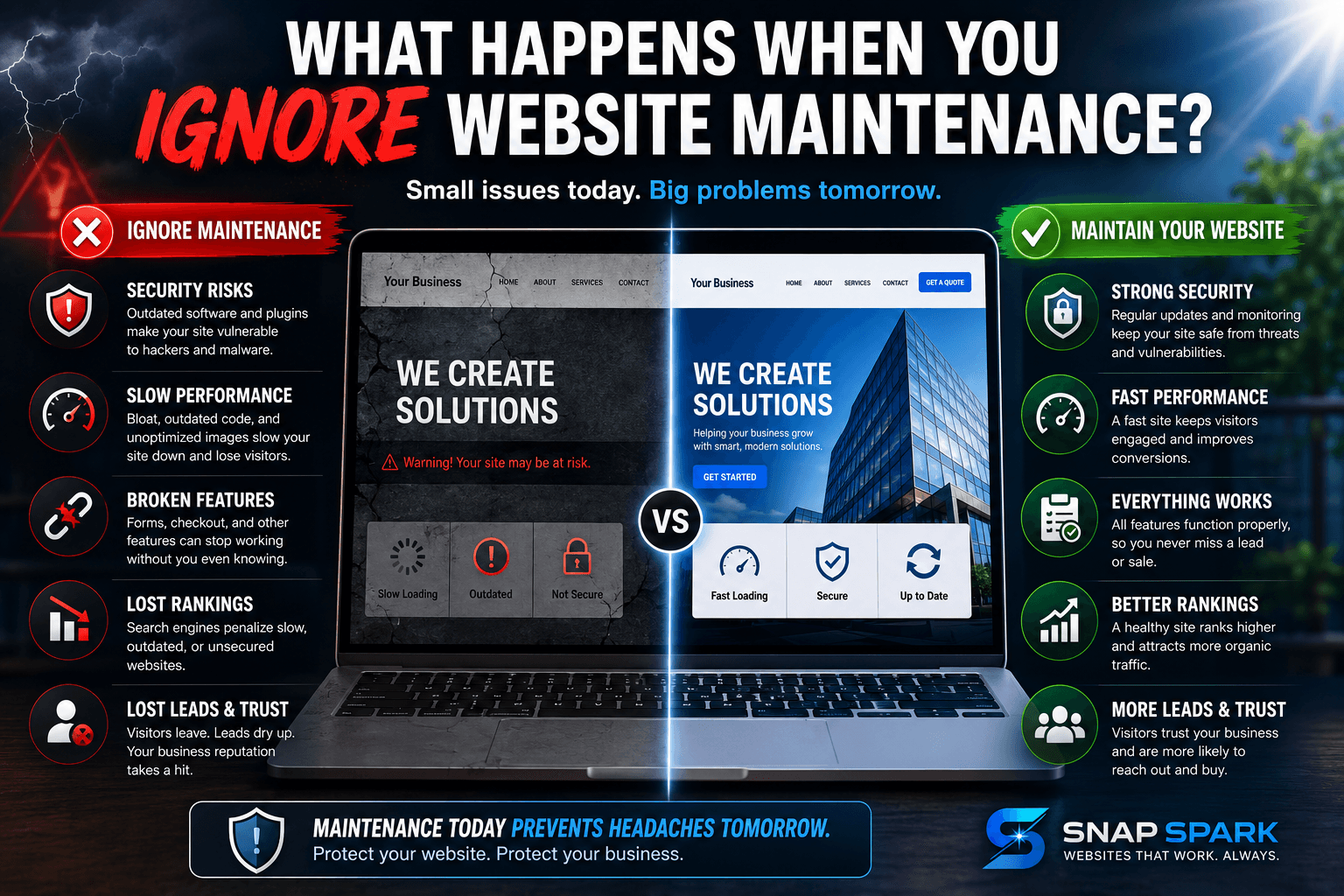
What Happens When You Ignore Website Maintenance?
Many business owners invest significant time and money into launching a website, only to neglect it once it goes live.
The website works, customers can find it, and everything appears fine on the surface.
Unfortunately, websites are not "set it and forget it" assets.
Just like a vehicle requires oil changes and a building requires upkeep, websites require ongoing maintenance to remain secure, functional, and effective.
The problem is that many website issues develop gradually. By the time a business owner notices a problem, the damage may have already occurred.
Ignoring website maintenance can lead to security vulnerabilities, poor performance, lost leads, declining search rankings, and expensive repairs.
Your Website Is Constantly Aging
Many business owners assume that because a website looks the same, it is performing the same.
That is rarely true.
The internet is constantly evolving.
Changes occur regularly in:
Browsers
Mobile devices
Search engine algorithms
Security standards
Website platforms
Software integrations
A website that performed well a few years ago may slowly become outdated if it is not maintained properly.
Without ongoing attention, even a professionally built website can begin to experience problems.
Security Risks Increase Over Time
Security is one of the biggest reasons website maintenance matters.
Hackers are constantly searching for vulnerabilities in outdated software, plugins, themes, and website platforms.
Common security risks include:
Malware infections
Website defacement
Spam injections
Unauthorized access
Data breaches
Blacklisting by search engines
Many website owners assume they are too small to become a target.
In reality, most website attacks are automated and target known vulnerabilities rather than specific businesses.
An outdated website can become vulnerable long before the owner realizes there is a problem.
Software Updates Are Important
Modern websites often rely on multiple layers of software.
These may include:
Website platforms
Plugins
Themes
Security tools
Forms
Ecommerce systems
Third-party integrations
Developers regularly release updates to:
Improve security
Fix bugs
Increase compatibility
Improve performance
Add features
Ignoring updates can cause conflicts, errors, and security vulnerabilities that impact website functionality.
Website Speed Can Gradually Decline
Website performance is not something that remains constant forever.
Over time, websites often accumulate:
Large images
Unused files
Outdated code
Broken links
Plugin conflicts
Database bloat
These issues can reduce performance and increase loading times.
Slow websites often experience:
Higher bounce rates
Lower engagement
Reduced conversions
Poor user experience
Lower search visibility
Many businesses lose opportunities simply because visitors leave before pages finish loading.
Search Rankings Can Suffer
Search engines want to provide users with the best possible experience.
A poorly maintained website may eventually develop issues that negatively affect rankings.
Examples include:
Broken pages
Missing content
Slow loading speeds
Mobile usability problems
Security warnings
Technical SEO errors
Even businesses with strong rankings can lose visibility if maintenance is ignored for long periods of time.
Broken Features Often Go Unnoticed
One of the most common website maintenance problems involves features breaking without anyone realizing it.
Examples include:
Contact forms
Appointment requests
Ecommerce checkout systems
Payment gateways
Email notifications
Lead generation forms
Imagine spending money on advertising only to discover months later that your contact form stopped working.
Unfortunately, situations like this happen more often than many business owners realize.
Regular maintenance helps identify problems before they begin affecting customers.
Backups Matter More Than Most Businesses Realize
Backups are one of the most overlooked parts of website management.
If a website experiences:
A hacking attempt
A software conflict
Server failure
Human error
Data corruption
A reliable backup can dramatically reduce recovery time.
Without backups, restoring a website can become expensive, time-consuming, or in some cases impossible.
Regular backup verification should be part of every website maintenance strategy.
Mobile Users Expect a Seamless Experience
Mobile traffic now accounts for the majority of website visits across many industries.
As devices, browsers, and operating systems evolve, websites should be tested regularly to ensure they continue functioning properly.
Common mobile issues include:
Layout problems
Navigation issues
Slow loading times
Broken buttons
Form submission errors
Even small usability issues can negatively impact conversions and customer experience.
Outdated Content Hurts Credibility
A website is often the first impression customers have of a business.
Outdated content can create confusion and reduce trust.
Examples include:
Old services
Expired promotions
Incorrect contact information
Former employees
Outdated pricing
Old project photos
Visitors may question whether a business is active or reliable when website information appears neglected.
Regular content reviews help ensure information remains accurate and relevant.
Small Problems Become Expensive Problems
One of the biggest reasons to perform regular maintenance is simple.
Small issues are usually easier and less expensive to fix.
Minor concerns can quickly grow into larger problems when ignored.
For example:
A plugin conflict becomes a broken website.
A security vulnerability becomes a malware infection.
A failed backup becomes data loss.
A slow website becomes lost customers.
Preventive maintenance is almost always less expensive than emergency repairs.
Website Maintenance Is About More Than Fixing Problems
Many business owners think maintenance only involves fixing issues.
In reality, effective maintenance is also about improvement.
Ongoing maintenance provides opportunities to:
Improve performance
Strengthen security
Update content
Enhance user experience
Improve search visibility
Increase conversions
Businesses that continuously improve their websites often outperform competitors that leave their websites unchanged for years.
Why Businesses Often Ignore Website Maintenance
Most business owners are busy running their companies.
Website maintenance often falls into the category of "I'll deal with it later."
The problem is that websites rarely announce when something is beginning to fail.
Issues often develop quietly in the background until they become serious enough to impact customers or revenue.
By that point, repairs are often more complicated and more expensive.
Final Thoughts
Website maintenance is one of the most overlooked investments a business can make.
While it may not be as exciting as launching a new website, ongoing maintenance plays a critical role in security, performance, search visibility, lead generation, and overall reliability.
A well-maintained website continues working for your business every day. An ignored website gradually becomes less secure, less effective, and more expensive to repair.
The businesses that consistently maintain their websites are often the same businesses that enjoy stronger performance, better customer experiences, and fewer costly surprises over the long term.
What Happens When You Ignore Website Maintenance?
Many business owners invest significant time and money into launching a website, only to neglect it once it goes live.
The website works, customers can find it, and everything appears fine on the surface.
Unfortunately, websites are not "set it and forget it" assets.
Just like a vehicle requires oil changes and a building requires upkeep, websites require ongoing maintenance to remain secure, functional, and effective.
The problem is that many website issues develop gradually. By the time a business owner notices a problem, the damage may have already occurred.
Ignoring website maintenance can lead to security vulnerabilities, poor performance, lost leads, declining search rankings, and expensive repairs.
Your Website Is Constantly Aging
Many business owners assume that because a website looks the same, it is performing the same.
That is rarely true.
The internet is constantly evolving.
Changes occur regularly in:
Browsers
Mobile devices
Search engine algorithms
Security standards
Website platforms
Software integrations
A website that performed well a few years ago may slowly become outdated if it is not maintained properly.
Without ongoing attention, even a professionally built website can begin to experience problems.
Security Risks Increase Over Time
Security is one of the biggest reasons website maintenance matters.
Hackers are constantly searching for vulnerabilities in outdated software, plugins, themes, and website platforms.
Common security risks include:
Malware infections
Website defacement
Spam injections
Unauthorized access
Data breaches
Blacklisting by search engines
Many website owners assume they are too small to become a target.
In reality, most website attacks are automated and target known vulnerabilities rather than specific businesses.
An outdated website can become vulnerable long before the owner realizes there is a problem.
Software Updates Are Important
Modern websites often rely on multiple layers of software.
These may include:
Website platforms
Plugins
Themes
Security tools
Forms
Ecommerce systems
Third-party integrations
Developers regularly release updates to:
Improve security
Fix bugs
Increase compatibility
Improve performance
Add features
Ignoring updates can cause conflicts, errors, and security vulnerabilities that impact website functionality.
Website Speed Can Gradually Decline
Website performance is not something that remains constant forever.
Over time, websites often accumulate:
Large images
Unused files
Outdated code
Broken links
Plugin conflicts
Database bloat
These issues can reduce performance and increase loading times.
Slow websites often experience:
Higher bounce rates
Lower engagement
Reduced conversions
Poor user experience
Lower search visibility
Many businesses lose opportunities simply because visitors leave before pages finish loading.
Search Rankings Can Suffer
Search engines want to provide users with the best possible experience.
A poorly maintained website may eventually develop issues that negatively affect rankings.
Examples include:
Broken pages
Missing content
Slow loading speeds
Mobile usability problems
Security warnings
Technical SEO errors
Even businesses with strong rankings can lose visibility if maintenance is ignored for long periods of time.
Broken Features Often Go Unnoticed
One of the most common website maintenance problems involves features breaking without anyone realizing it.
Examples include:
Contact forms
Appointment requests
Ecommerce checkout systems
Payment gateways
Email notifications
Lead generation forms
Imagine spending money on advertising only to discover months later that your contact form stopped working.
Unfortunately, situations like this happen more often than many business owners realize.
Regular maintenance helps identify problems before they begin affecting customers.
Backups Matter More Than Most Businesses Realize
Backups are one of the most overlooked parts of website management.
If a website experiences:
A hacking attempt
A software conflict
Server failure
Human error
Data corruption
A reliable backup can dramatically reduce recovery time.
Without backups, restoring a website can become expensive, time-consuming, or in some cases impossible.
Regular backup verification should be part of every website maintenance strategy.
Mobile Users Expect a Seamless Experience
Mobile traffic now accounts for the majority of website visits across many industries.
As devices, browsers, and operating systems evolve, websites should be tested regularly to ensure they continue functioning properly.
Common mobile issues include:
Layout problems
Navigation issues
Slow loading times
Broken buttons
Form submission errors
Even small usability issues can negatively impact conversions and customer experience.
Outdated Content Hurts Credibility
A website is often the first impression customers have of a business.
Outdated content can create confusion and reduce trust.
Examples include:
Old services
Expired promotions
Incorrect contact information
Former employees
Outdated pricing
Old project photos
Visitors may question whether a business is active or reliable when website information appears neglected.
Regular content reviews help ensure information remains accurate and relevant.
Small Problems Become Expensive Problems
One of the biggest reasons to perform regular maintenance is simple.
Small issues are usually easier and less expensive to fix.
Minor concerns can quickly grow into larger problems when ignored.
For example:
A plugin conflict becomes a broken website.
A security vulnerability becomes a malware infection.
A failed backup becomes data loss.
A slow website becomes lost customers.
Preventive maintenance is almost always less expensive than emergency repairs.
Website Maintenance Is About More Than Fixing Problems
Many business owners think maintenance only involves fixing issues.
In reality, effective maintenance is also about improvement.
Ongoing maintenance provides opportunities to:
Improve performance
Strengthen security
Update content
Enhance user experience
Improve search visibility
Increase conversions
Businesses that continuously improve their websites often outperform competitors that leave their websites unchanged for years.
Why Businesses Often Ignore Website Maintenance
Most business owners are busy running their companies.
Website maintenance often falls into the category of "I'll deal with it later."
The problem is that websites rarely announce when something is beginning to fail.
Issues often develop quietly in the background until they become serious enough to impact customers or revenue.
By that point, repairs are often more complicated and more expensive.
Final Thoughts
Website maintenance is one of the most overlooked investments a business can make.
While it may not be as exciting as launching a new website, ongoing maintenance plays a critical role in security, performance, search visibility, lead generation, and overall reliability.
A well-maintained website continues working for your business every day. An ignored website gradually becomes less secure, less effective, and more expensive to repair.
The businesses that consistently maintain their websites are often the same businesses that enjoy stronger performance, better customer experiences, and fewer costly surprises over the long term.
Recent post
Ready to Strengthen Your Online Presence?
Whether you need a new website, better visibility on Google, or a strategy for growth, Snap Spark can help you build a stronger digital presence.
Ready to Strengthen Your Online Presence?
Whether you need a new website, better visibility on Google, or a strategy for growth, Snap Spark can help you build a stronger digital presence.
Ready to Strengthen Your Online Presence?
Whether you need a new website, better visibility on Google, or a strategy for growth, Snap Spark can help you build a stronger digital presence.