Latest Insights
Blog details
Blog details
Explore practical insights on websites, SEO, online visibility, and digital strategy to help your business grow online.
Explore practical insights on websites, SEO, online visibility, and digital strategy to help your business grow online.
Website Design, Platform Migrations
How to Choose the Right Website Platform for Long-Term Business Growth
Choosing a website platform is about more than launching a website today. Learn how to evaluate scalability, flexibility, maintenance, and future business needs before making a long-term investment.
How to Choose the Right Website Platform for Long-Term Business Growth
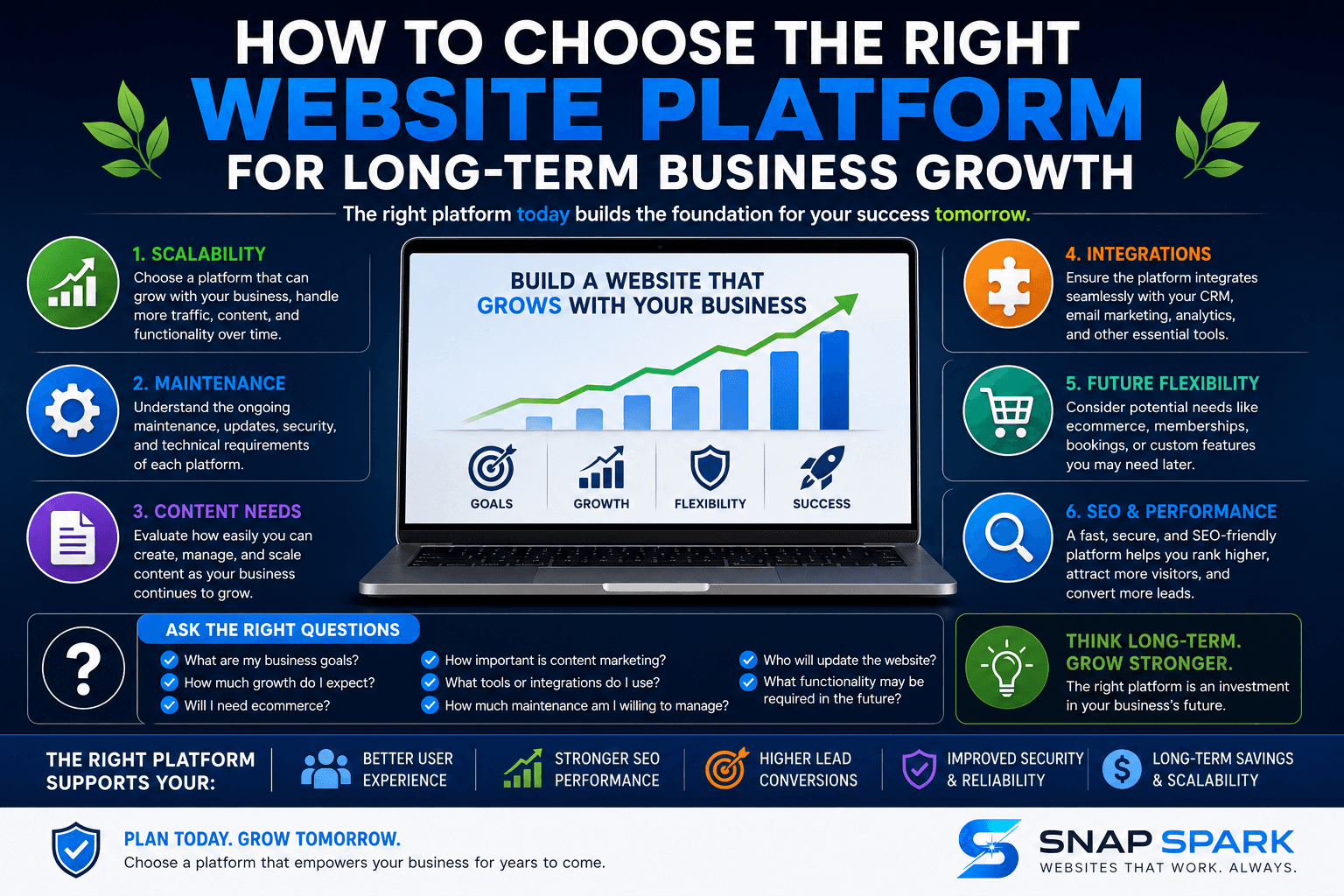
Choosing a website platform is one of the most important technology decisions a business will make.
Unfortunately, many businesses select a platform based solely on cost, convenience, or a recommendation from a friend.
While those factors may seem important initially, they often become less important as a business grows.
A website platform should not only meet your needs today. It should also support where your business will be one, three, and five years from now.
Making the wrong decision can lead to limitations, expensive migrations, lost opportunities, and unnecessary frustration.
Understanding what to evaluate before choosing a platform can help prevent those problems.
Think Beyond Launch Day
Many businesses focus entirely on getting a website online.
The excitement of launching a new website often overshadows more important questions.
For example:
What happens when the business grows?
What if new services are added?
What if ecommerce becomes necessary?
What if traffic increases significantly?
What if multiple team members need access?
A platform that feels perfect today may become restrictive tomorrow.
Long-term planning should always be part of the decision-making process.
Consider Your Business Goals
Before evaluating platforms, it is important to define your goals.
Different businesses have very different requirements.
A local service business may need:
Lead generation
Contact forms
Service pages
Local SEO
An ecommerce business may require:
Product management
Inventory tracking
Payment processing
Shipping integrations
A content-focused business may prioritize:
Blogging
Resource libraries
Content management
Search visibility
Understanding your goals helps narrow the list of platforms that make sense.
Scalability Matters
Scalability refers to a platform's ability to grow alongside your business.
Many businesses choose a platform that works well when they are small but struggles to keep up as they expand.
Questions to consider include:
Can additional pages be added easily?
Can new functionality be added later?
Can traffic increase without problems?
Can the platform support future marketing efforts?
Can additional team members manage content?
The more growth you anticipate, the more important scalability becomes.
Consider Maintenance Requirements
Every website platform requires some level of maintenance.
The difference is how much responsibility falls on the business owner.
Some platforms require:
Software updates
Plugin management
Security monitoring
Backup management
Performance optimization
Other platforms handle many of these responsibilities automatically.
When evaluating platforms, consider:
How much maintenance are you willing to manage?
Do you have technical experience?
Will you have professional support available?
Maintenance should always be considered part of the total cost of ownership.
Understand Your Content Needs
Content plays a major role in modern marketing.
Businesses often underestimate how much content they will create over time.
Examples include:
Service pages
Blog posts
Case studies
Project galleries
FAQs
Resource guides
The platform you choose should make content management efficient and scalable.
A platform that becomes difficult to manage as content grows can create long-term challenges.
Marketing Integrations Are Critical
Modern websites rarely operate in isolation.
Most businesses rely on additional tools to support marketing and sales efforts.
Common integrations include:
CRM systems
Email marketing platforms
Scheduling software
Analytics tools
Advertising platforms
Form management systems
Before selecting a platform, verify that it can integrate with the tools your business currently uses or may use in the future.
Ecommerce May Become Important Later
Many businesses launch websites without plans to sell products online.
Over time, however, opportunities often emerge.
Examples include:
Merchandise
Digital products
Memberships
Online courses
Gift cards
Physical products
Even if ecommerce is not needed today, it may become valuable later.
Considering future ecommerce requirements can help avoid costly migrations.
SEO Should Never Be an Afterthought
Search visibility plays a significant role in long-term website success.
A platform should support:
Search-friendly URLs
Metadata management
Mobile optimization
Fast loading speeds
Structured content
Technical SEO best practices
While most modern platforms can support SEO, some make optimization easier than others.
The platform should support your marketing goals rather than create obstacles.
User Experience Impacts Growth
Visitors expect websites to be:
Fast
Easy to navigate
Mobile friendly
Professional
Reliable
A platform should support a positive user experience without requiring constant workarounds.
Poor user experiences often result in:
Higher bounce rates
Lower engagement
Reduced trust
Fewer conversions
Choosing a platform capable of delivering excellent user experiences helps support long-term business growth.
Migrations Can Be Expensive
One of the most overlooked considerations is the cost of changing platforms later.
Website migrations often involve:
Content transfers
Design recreation
SEO preservation
Redirect management
Technical testing
While migrations can be successful, they often require significant time and effort.
Choosing the right platform from the beginning can help minimize future disruption.
Questions Every Business Owner Should Ask
Before choosing a website platform, ask yourself:
What are my business goals?
How much growth do I expect?
Will I need ecommerce?
How important is content marketing?
What marketing tools do I use?
How much maintenance am I willing to manage?
Who will update the website?
What functionality may be required in the future?
The answers often reveal which platform is the best fit.
There Is No One-Size-Fits-All Solution
One of the biggest mistakes businesses make is searching for the "best" platform.
The reality is that every platform has strengths and weaknesses.
What works perfectly for one business may be completely wrong for another.
The goal is not finding the most popular platform.
The goal is finding the platform that best supports your business objectives, operational needs, marketing strategy, and future growth plans.
Final Thoughts
A website platform is not just a technology decision. It is a business decision.
The platform you choose today can influence your website's flexibility, scalability, maintenance requirements, marketing capabilities, and long-term success.
Taking the time to evaluate future growth, content needs, integrations, user experience, SEO requirements, and maintenance responsibilities can help you make a more informed decision.
The businesses that think beyond launch day are often the ones that avoid costly migrations and position themselves for stronger long-term growth.
How to Choose the Right Website Platform for Long-Term Business Growth
Choosing a website platform is one of the most important technology decisions a business will make.
Unfortunately, many businesses select a platform based solely on cost, convenience, or a recommendation from a friend.
While those factors may seem important initially, they often become less important as a business grows.
A website platform should not only meet your needs today. It should also support where your business will be one, three, and five years from now.
Making the wrong decision can lead to limitations, expensive migrations, lost opportunities, and unnecessary frustration.
Understanding what to evaluate before choosing a platform can help prevent those problems.
Think Beyond Launch Day
Many businesses focus entirely on getting a website online.
The excitement of launching a new website often overshadows more important questions.
For example:
What happens when the business grows?
What if new services are added?
What if ecommerce becomes necessary?
What if traffic increases significantly?
What if multiple team members need access?
A platform that feels perfect today may become restrictive tomorrow.
Long-term planning should always be part of the decision-making process.
Consider Your Business Goals
Before evaluating platforms, it is important to define your goals.
Different businesses have very different requirements.
A local service business may need:
Lead generation
Contact forms
Service pages
Local SEO
An ecommerce business may require:
Product management
Inventory tracking
Payment processing
Shipping integrations
A content-focused business may prioritize:
Blogging
Resource libraries
Content management
Search visibility
Understanding your goals helps narrow the list of platforms that make sense.
Scalability Matters
Scalability refers to a platform's ability to grow alongside your business.
Many businesses choose a platform that works well when they are small but struggles to keep up as they expand.
Questions to consider include:
Can additional pages be added easily?
Can new functionality be added later?
Can traffic increase without problems?
Can the platform support future marketing efforts?
Can additional team members manage content?
The more growth you anticipate, the more important scalability becomes.
Consider Maintenance Requirements
Every website platform requires some level of maintenance.
The difference is how much responsibility falls on the business owner.
Some platforms require:
Software updates
Plugin management
Security monitoring
Backup management
Performance optimization
Other platforms handle many of these responsibilities automatically.
When evaluating platforms, consider:
How much maintenance are you willing to manage?
Do you have technical experience?
Will you have professional support available?
Maintenance should always be considered part of the total cost of ownership.
Understand Your Content Needs
Content plays a major role in modern marketing.
Businesses often underestimate how much content they will create over time.
Examples include:
Service pages
Blog posts
Case studies
Project galleries
FAQs
Resource guides
The platform you choose should make content management efficient and scalable.
A platform that becomes difficult to manage as content grows can create long-term challenges.
Marketing Integrations Are Critical
Modern websites rarely operate in isolation.
Most businesses rely on additional tools to support marketing and sales efforts.
Common integrations include:
CRM systems
Email marketing platforms
Scheduling software
Analytics tools
Advertising platforms
Form management systems
Before selecting a platform, verify that it can integrate with the tools your business currently uses or may use in the future.
Ecommerce May Become Important Later
Many businesses launch websites without plans to sell products online.
Over time, however, opportunities often emerge.
Examples include:
Merchandise
Digital products
Memberships
Online courses
Gift cards
Physical products
Even if ecommerce is not needed today, it may become valuable later.
Considering future ecommerce requirements can help avoid costly migrations.
SEO Should Never Be an Afterthought
Search visibility plays a significant role in long-term website success.
A platform should support:
Search-friendly URLs
Metadata management
Mobile optimization
Fast loading speeds
Structured content
Technical SEO best practices
While most modern platforms can support SEO, some make optimization easier than others.
The platform should support your marketing goals rather than create obstacles.
User Experience Impacts Growth
Visitors expect websites to be:
Fast
Easy to navigate
Mobile friendly
Professional
Reliable
A platform should support a positive user experience without requiring constant workarounds.
Poor user experiences often result in:
Higher bounce rates
Lower engagement
Reduced trust
Fewer conversions
Choosing a platform capable of delivering excellent user experiences helps support long-term business growth.
Migrations Can Be Expensive
One of the most overlooked considerations is the cost of changing platforms later.
Website migrations often involve:
Content transfers
Design recreation
SEO preservation
Redirect management
Technical testing
While migrations can be successful, they often require significant time and effort.
Choosing the right platform from the beginning can help minimize future disruption.
Questions Every Business Owner Should Ask
Before choosing a website platform, ask yourself:
What are my business goals?
How much growth do I expect?
Will I need ecommerce?
How important is content marketing?
What marketing tools do I use?
How much maintenance am I willing to manage?
Who will update the website?
What functionality may be required in the future?
The answers often reveal which platform is the best fit.
There Is No One-Size-Fits-All Solution
One of the biggest mistakes businesses make is searching for the "best" platform.
The reality is that every platform has strengths and weaknesses.
What works perfectly for one business may be completely wrong for another.
The goal is not finding the most popular platform.
The goal is finding the platform that best supports your business objectives, operational needs, marketing strategy, and future growth plans.
Final Thoughts
A website platform is not just a technology decision. It is a business decision.
The platform you choose today can influence your website's flexibility, scalability, maintenance requirements, marketing capabilities, and long-term success.
Taking the time to evaluate future growth, content needs, integrations, user experience, SEO requirements, and maintenance responsibilities can help you make a more informed decision.
The businesses that think beyond launch day are often the ones that avoid costly migrations and position themselves for stronger long-term growth.
Recent post
Ready to Strengthen Your Online Presence?
Whether you need a new website, better visibility on Google, or a strategy for growth, Snap Spark can help you build a stronger digital presence.
Ready to Strengthen Your Online Presence?
Whether you need a new website, better visibility on Google, or a strategy for growth, Snap Spark can help you build a stronger digital presence.
Ready to Strengthen Your Online Presence?
Whether you need a new website, better visibility on Google, or a strategy for growth, Snap Spark can help you build a stronger digital presence.